Forget Gift Baskets. Give Your Teams a Shared Operating Model Instead.
The holidays are a time of giving, and if you’re a business leader you’ve got a lot of teams on your gift list.
Finding the “perfect” gift for each one is hard—especially when what they really want is a lot more complex than woolly socks.
Marketing wants cross-team alignment so different groups stop interpreting the same objective in different ways and running in different directions.
Sales wants quality leads, so they spend more time converting and less time prospecting.
Creative wants predictability so they can spend less time reacting to last-minute “custom” requests and more time building work that performs.
Customer Service wants visibility so they can spend less time chasing data across systems and more time anticipating and solving issues.
IT wants rationalization, so they can consolidate the ever-growing “mission-critical” stack into scalable, manageable solutions.
Finance wants relevant results so they can translate marketing-by-channel, sales-by-territory, and service-by-customer reports into a clear view of business performance.
Operations wants automation so they can stop manually gluing systems, teams, and data together and start refining and optimizing processes.
Product Design wants consistency so they can work from a stable view of target audiences, needs, and priorities that doesn’t change week to week.
And you want peace on earth—or at least peace among your teams.
What’s a business leader to do?
Sometimes the best gifts are the simplest.
You don’t have the time, budget, or know-how to get everyone their specific gift, and you don’t like to play favorites.
You need one gift everyone can use.
Something meaningful to each team, authentic to you, and powerful enough to pull the organization together.
A gift you don’t buy—but make.
Part of your job as a business leader is to provide a clear vision and a simple framework so your teams can understand how the business works and how their skills and responsibilities contribute to its objectives.
So paint them a picture and tell them a story.
Paint a simple picture
The picture doesn’t have to be complicated. In fact, the simpler it is, the more likely it is that everyone can understand and use it.
At the end of the day, every company exists to provide goods or services to customers in exchange for some form of compensation. In that sense, every company is in the customer-relationship business.
And every customer relationship follows the same basic lifecycle:
Customers discover a product or service exists.
They choose to acquire it.
They use or experience it.
They decide whether to keep, renew, or rebuy it.
The picture looks something like this:
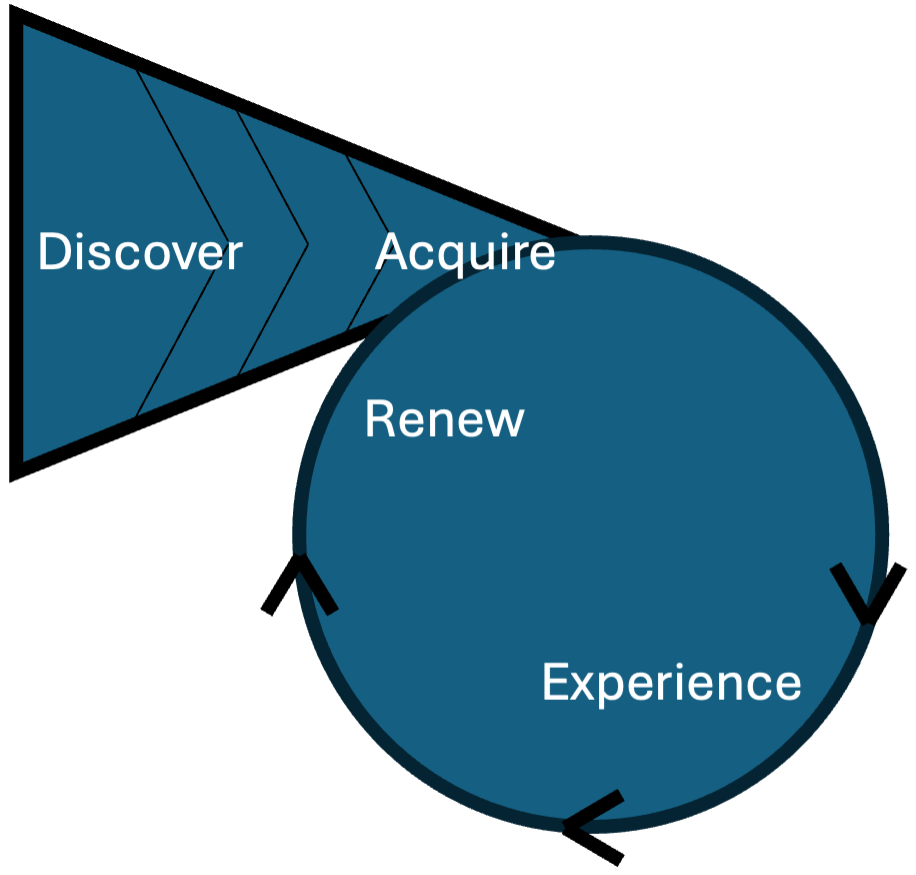
Different businesses have their own version of a customer journey. But this basic framework holds.
This simple picture delivers a lot of value:
It gives everyone a logical, shared frame of reference to discuss customer engagement.
Every team can see themselves on it.
For example:
Marketing and Sales drive discovery and acquisition.
Product Design and Customer Service shape the experience.
Marketing, Sales, and Customer Service drive renewal and retention.
Creative, IT, Finance, and Operations deliver the experiences and make it all work.
With a shared lifecycle, teams can clearly see their role, align priorities, and understand their upstream inputs and downstream impact.
That alone is a pretty good gift.
Tell a shared story
A picture is powerful. But it’s just as important that teams share a language to describe what happens on that picture.
Fortunately, just as every customer lifecycle follows the same pattern, every engagement along that lifecycle can be described with the same simple set of categories.
Who is being engaged? (audience segment / identity)
What are they engaging with? (content / experience)
Where is the engagement happening? (channel / location)
When is it happening? (time / cadence / priority)
Why is it happening? (business objective / need)
How is it happening? (plan / playbook / process)
These six simple questions, answered consistently, can describe any engagement, with any audience, for any reason, in any part of the business.
By breaking the description down into these smaller pieces each data point is easier to supply and govern, the same terms can be reused across tools, teams, and reports, and your company develops a shared vocabulary everyone can understand.
That combination—a shared picture and a shared language—is a pretty wonderful set of gifts to give your teams.
The gift that keeps giving
This shared vocabulary is immensely powerful. With it, a lot of the wishes on each team’s list can come true.
Marketing can share audience, content, and playbook definitions across teams, so cross-platform plans line up instead of compete.
Sales gets scoring models and routing rules built on familiar data, so leads make sense and follow-up is faster.
Creative receives briefs tagged with standardized, reusable metadata, so they know when to create net-new work and when to reuse what already exists.
Customer Service sees data from different platforms described in the same way, so they have a complete view of the customer experience.
IT configures applications around the same core metadata, so integrations are cleaner and overlapping tools are easier to rationalize.
Finance ties playbooks and projects to lifecycle-based KPIs and business priorities, so marketing, sales, and service results roll up into a clear financial story.
Operations works with well-governed metadata, so automation and agentic solutions become more robust and less brittle.
Product Design sees audiences, needs, and business objectives described consistently, so offerings can be built to stand the test of time.
One simple set of definitions. A lot of happy teams.
The elves have already done the hard work
Designing and implementing a workable customer-engagement data framework can feel overwhelming.
The good news: a lot of that work already exists.
At Schema6, we’ve developed
· A proven framework based on these six questions (the “6Qs”) that can be applied to any company,
· Pre-built solutions that show where and how to apply the framework to drive immediate, tangible improvements,
· Implementation strategies that work locally—inside individual teams or systems—but stays consistent as it scales, so separate efforts can be stitched together into a unified, enterprise-level operating model.
So before you buy another gift basket, consider giving your org the one thing that changes outcomes: a shared operating model.
Reach out and we’ll help you get there.